Showing posts with label Faculty Focus. Show all posts

Monday, 3 August 2015

Instructional Design Principles

It's done! Another course completed. This latest course was How to Design an e-Learning Program from the University of Toronto's Continuing Education. I have now completed 3 of the 5 courses for the E-learning Certificate. Yeah!

Even if I was familiar with most of the topics, it was great to learn about these in more detail. It turns out that following a few e-learning and design blogs has kept me up-to-date with what's happening. It was great to find other sources of information and inspiration through this course. I’ll be sharing some of these with you.

My intent was to write a post on what I learned in the course, but after reviewing my course notes and assignments, I have enough ideas for at least three posts. This is good news since this blog is neglected compared to my Quilting blog.

Here are some of the topics and ideas that stood out and how I’ve been able to apply some of these.

What I learned (Part 1):

Instructional Design Principles (or rules worth following when designing e-learning course)

My first assignment involved identifying instructional design principles to follow during the design of my project. Finding these on the internet wasn’t easy because they are rarely identified as principles. Here are some of my favourites, sorted by source. My observations are in the bullet
following the principle.
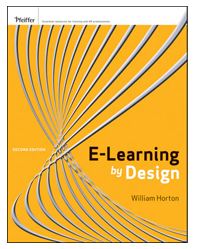
E-Learning by Design

E-Learning by Design by William Horton
  • Teach only what they “need to know”; what is essential; skills required in their jobs.
    • This can be difficult because we love learning and think everything is important. It’s not!
  • Ensure that they can skip what they already know and what they could learn on their own. 
    • The trick here is to make sure that they already know it or that they can come back if they find out they didn’t know it all.
  • Base the design on clear goals that are important to the organisation.
    • It was an interesting and worthwhile exercise to link the course goals to my organisation’s goals. 
Quick Survival Guide for Modern eLearning Designers
Quick Survival Guide 
A Quick Survival Guide for Modern eLearning Designers  (it’s a free download worth getting)
  • Use visuals to explain the content normally write out as a screen filled with bullet points.
    • An image can sometimes put the information in context. I really try to avoid the wall of words, whether it’s in e-learning or on the internet.
  • Every element of the design needs to have a purpose.
    • Excellent idea that applies to content as well as graphics etc.
  • If someone can say it better than you, then let them (link up to their blog, article or video).
    • Faculty Focus Blog
      Faculty Focus Blog
    • Not easy to do when things need to be bilingual but wise none-the-less.
  • Use a consistant format.
    • This is key for a professional looking product. Attention to detail is important here.
  • It takes longer than you think to create online content! 
    • Doesn't that apply to all project?
I’m not sure that I consciously kept these principles in mind, but I did use them. Not only are the principles relevant, but all three sources are excellent.

I hope that you have time to check these out!


Friday, 2 August 2013

Breaking Down Assumptions

I wanted to keep up this blog but I wanted it to be larger than web design. It took me a while to break through the assumption that this blog doesn't have to be only about web design. With a name like Learning & Design, why not talk about creating learning design, course design, learning about course design, learning from course design, etc.? That sounds like a plan.

I've been receiving Faculty Focus – an e-magazine of sorts about “higher ed teaching strategies from Magna Publications”. Although written for college and university teachers, many of the issues and topics relate to the larger world of adult education outside of these specific institutions. What I love about the publication is that the articles may reference scholarly publications, but the topics and the writing is very practical.

Here is a great technique for engaging students and encouraging them to participate.

Today’s article is Using a Blog to Enhance Student Participation by Maryellen Weimer, PhD. The article, about using a blog assignment to enhance student participation within an in-class course, appealed to me because this is similar to what I just experienced in my Visual Design and Display of Information course. I agree that a blog is a great forum to reflect on the course’s ideas.

Dr. Weimer has some great ideas about how to use the blog. Here are the highlights:

  • The blog assignment was used throughout the course to respond to that week’s readings and to connect it to current events. They had to write a minimum of 300 words to address that week’s topic and also reflect on the ideas of at least one other blogger from their class.
  • The student bloggers remained anonymous by using user-names that were only known by the teacher.
  • The teacher reviewed the blogs the evening before the class to help her gauge the students’ understanding of the subject.
  • In class, she uses the printed blog posts to highlight insightful responses, good questions and exchanges, and correct inaccuracies.
It turns out that several of the students who did not participate in class did participate well in the blog discussions. This isn't surprising since many introverts need to think things through before talking (and of course, some of them are shy). This assignment would give them time to think of their responses without standing out in the class. A great combination for many introverts!

Although I enjoyed creating the blog for my course, I think that having an anonymous component as well as at least a little bit of a requirement to respond to another student’s blog could have added to the course. We were encouraged to share our blog addresses with our fellow students, but most did not. This might have helped students feel safer about sharing.